The Molecular Mechanics of Resilience: Heat-Shock Proteins and Thermal Stress in Marine Bivalves
A. A. Zubair *
PG and Research Department of Aquaculture and Fishery Microbiology, MES Ponnani College, Kerala, India.
*Author to whom correspondence should be addressed.
Abstract
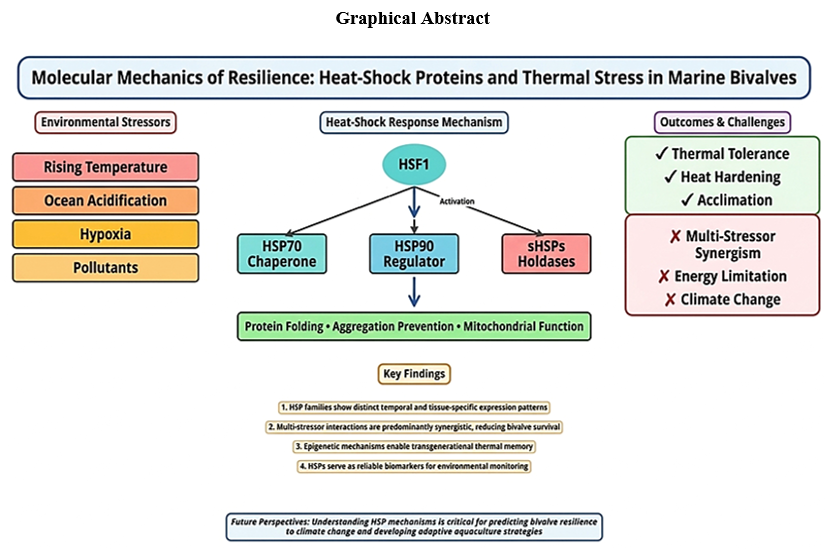
Marine bivalves — oysters, mussels, clams and scallops are ecologically important and economically valuable. These organisms are increasingly vulnerable as climate-driven thermal stress and marine heatwaves (MHWs) become more frequent. Not surprisingly, survival is highly dependent on the heat-shock response (HSR). This conserved cellular program is preserved and regulated through heat-shock proteins (HSPs), which promote protein homeostasis during thermal extremes. This review synthesizes existing knowledge of bivalve HSP biology about molecular chaperones, including HSP90, HSP70, HSP60 and small HSPs. It explores their regulation by heat-shock factor 1 (HSF1) and the intercrossing of these neurons with unfolded protein response (UPR) and antioxidant pathways. Given that bivalves are frequently dealt a hand of simultaneous threats, the interactions between heat stress and other stressors (e.g. ocean acidification, hypoxia, and pollution) are also evaluated. Omics" evidence is used to highlight how these responses differ across various species and tissues. Discussion focuses on physiological plasticity, an epigenetic memory of past thermal background and selective breeding strategies aimed at increasing the resiliency of aquaculture. This study also makes a critical assessment concerning the usefulness of HSPs to act as environmental biomarkers. In examining these issues, the review defines both gaps in current knowledge and strengths of understanding that could be immediately built upon to effectively manage bivalves within a changing ocean. Narrative reviews summarize qualitative and significant quantitative evidence to give users comprehensive overviews of complex area-related topics, synthesizing information across multiple disciplines and research from 2000 to 2025 period.
Keywords: Aquaculture, biomarkers, climate change, epigenetics, Heat-shock proteins, marine bivalves, molecular chaperones, ocean acidification