Evaluation of Functional and Textural Characteristics of Fish Mince Sausages Prepared Using Microbial Transglutaminase (MTGase)
Sandeep B. Gore

Department of Fisheries Engineering, College of Fishery Science, Nagpur – 440001, Maharashtra, India.
Sagar A. Joshi
Department of Fish Processing Technology, College of Fishery Science, Nagpur – 440001, Maharashtra, India.
Amjad K. Balange
*
Division of Animal, Poultry and Fisheries Science, Indian Agricultural Research Institute (IARI), Dirpai Chapori, Gogamukh, Dhemaji District, Assam, India.
Shailendra S. Relekar
Department of Fish Processing Technology, College of Fishery Science, Nagpur – 440001, Maharashtra, India.
*Author to whom correspondence should be addressed.
Abstract
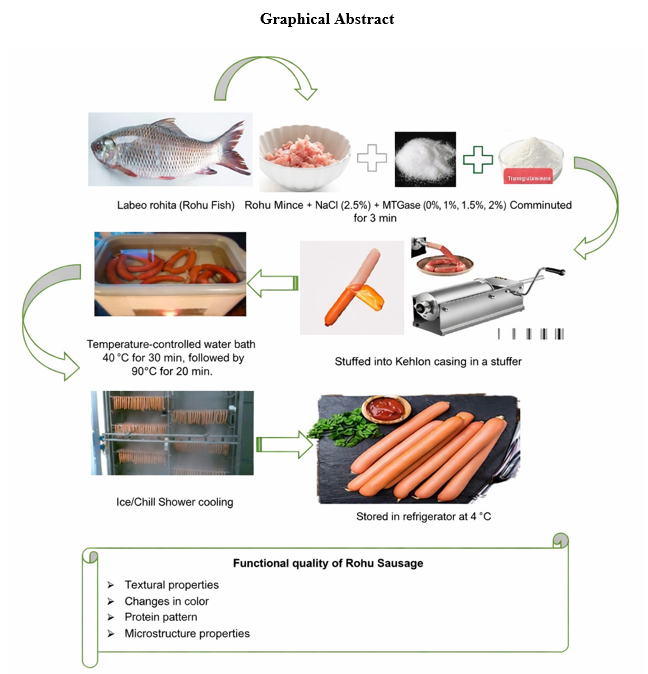
Microbial transglutaminase (MTGase) is widely used in food processing to improve the structural and functional properties of protein-based products through enzymatic cross-linking. The present study evaluated the influence of different concentrations of MTGase on the functional and textural characteristics of fish mince sausages prepared from Labeo rohita. Fish mince incorporated with varying levels (0, 0.5, 1.0 and 1.5%) of MTGase was processed into sausages and evaluated for functional properties such as water-holding capacity, cooking yield, and emulsion stability. Textural characteristics including gel strength and texture profile parameters were also determined. The results indicated statistically significant improvements (p < 0.05) in gel strength and water-holding capacity with increasing MTGase levels, with the optimal concentration producing sausages with superior structural integrity and desirable texture. These findings suggest that MTGase can be effectively utilized for the development of high-quality value-added fish products.
Keywords: Labeo rohita, color, gel strength, microstructure, microbial transglutaminase, mince, sausages, texture