Engineering a Solution: Recent Technological Advances in the Microbial Bioremediation of Microplastics
Zubair AA *
PG and Research Department of Aquaculture and Fishery Microbiology, MES Ponnani College, Kerala, India.
*Author to whom correspondence should be addressed.
Abstract
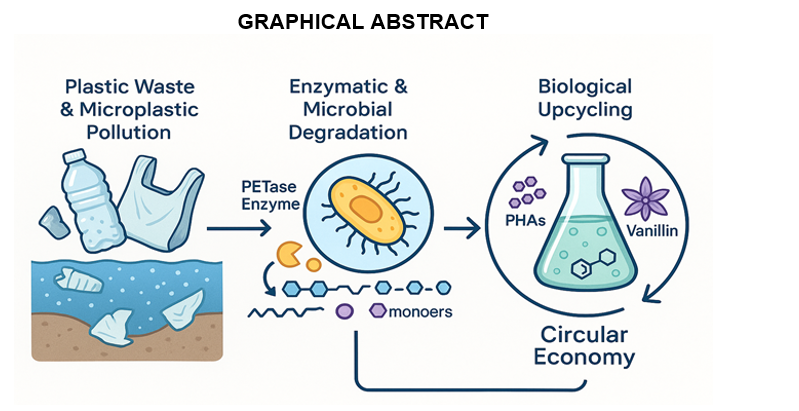
Plastic pollution, especially in the form of microplastics less than 5 mm in size, is a major environmental issue to ecosystems at various levels globally. However, classical treatments like mechanical recycling and incineration show various shortcomings in terms of cost/energy efficiency, as well as harmful by-products generation but biological strategies involving microorganisms look promising for the sustainable options. Here, recent technology development for microbial biotechnological plastic degradation are systematically reviewed with a focus on four principal areas: (1) optimization of the enzymatic toolbox as industrial standard for plastic depolymerization, (2) manipulation of suitable microbial hosts to boost efficiency and productivity of degradation activities in vivo, (3) current bottleneck preventing direct implementation under environmental conditions, and (4) biological recycling principle for waste-to-value concept. Plastic-degrading enzymes, including PETase and MHETase from Ideonella sakaiensis, developed by rational design and directed evolution are detailed in the review that describes how through the application of protein engineering these genes have been recovered as highly stable and efficient catalysts. Metabolic engineering strategies using model organisms such as Escherichia coli and Pseudomonas putida are spotlighted, highlighting enzyme overexpression approaches and pathway tuning through CRISPR/Cas9 genome editing or cell-surface display systems. The critical challenges that hinder in vivo translation are examined, with discussions of polymer crystallinity, biofilm manipulation, microbial competition, enzyme stability and environmental conditions. The most revolutionizing advance in this area of research is the move from “destruction” to biological upcycling where monomers, or terephthalic acid derived from plastic, are converted into useful products such as bio-plastics (polyhydroxyalkanoates), vanillin for food flavorants; and platform chemicals for industrial use. This would convert plastic waste from a pollutant to an economically attractive carbon resource, thereby promoting the economic drivers for plastics remediation and contributing to the development of a circular bio-based economy. The combination of synthetic biology, metabolic engineering and environmental biotechnology provides a green solution for the current most recognizable ecological concern.
Keywords: Microplastics, bioremediation, biodegradation, plastic-degrading enzymes, PETase, metabolic engineering, synthetic biology, biological upcycling, circular economy, Pseudomonas putida