Larvicidal and Molecular Docking Evaluation of Stephanotis volubilis Leaf Phytochemicals against Culex quinquefasciatus Odorant-Binding and D7 Proteins
Mowniga G.S.
Department of Zoology, St. Xavier’s College (Autonomous), Palayamkottai, Tamil Nadu, India.
Ramkumar R.
Department of Zoology, St. Xavier’s College (Autonomous), Palayamkottai, Tamil Nadu, India.
Azhagu Raj R. *
Department of Zoology, St. Xavier’s College (Autonomous), Palayamkottai, Tamil Nadu, India.
*Author to whom correspondence should be addressed.
Abstract
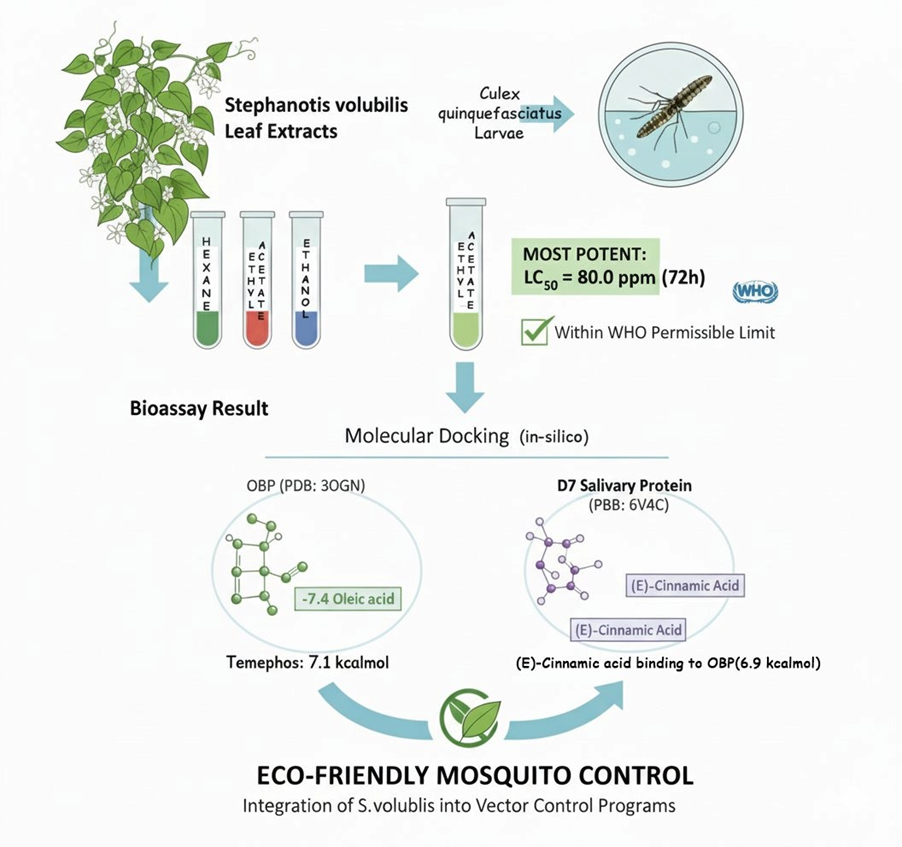
Vector-borne diseases pose a significant worldwide health threat, and the dependence on synthetic insect repellents has led to the development of resistance and ecological damage. This study investigated the larvicidal potential of Stephanotis volubilis (Apocynaceae) leaf extracts against the vector Culex quinquefasciatus (Diptera: Culicidae) and explored the underlying mechanisms through in-silico molecular docking. Larvicidal bioassay using Hexane, Ethyl acetate, and Ethanol extracts was conducted as per WHO guidelines. All extracts demonstrated concentration and time-dependent mortality against Cx. quinquefasciatus larvae. The Ethyl acetate extract was the most potent, recording an LC50 value of 101.3 ppm at 24 hours, which decreased to 80.0 ppm at 72 hours. This 72-hour LC50 value is within the WHO’s permissible threshold for plant-based larvicides. Molecular docking studies were performed using four phyto constituents against two critical mosquito targets: Odorant Binding Protein (OBP) PDB:3OGN and D7 Salivary Protein (PDB: 6V4C). Oleic acid showed the highest binding affinity for OBP at -7.4 kcal/mol, which was superior to the synthetic insecticide Temephos -7.1 kcal/mol. (E) -Cinnamic acid also bound strongly to the D7 Salivary Protein -6.7 kcal/mol and Temephos -6.2 kcal/mol. In conclusion, S. volubilis leaf extracts exhibit potent larvicidal activity. The moderate correlation (r = 0.78) between in vitro larvicidal activity and in-silico binding energies suggests these phytochemicals disrupt mosquito physiology through multiple mechanisms. S.volubilis phytochemicals demonstrate WHO-compliant larvicidal efficacy with superior molecular binding than the synthetic controls, validating their potential as eco-friendly alternatives for integrated vector management.
GRAPHICAL ABSTRACT
Keywords: Stephanotis volubilis, mosquitoes, Culex quinquefasciatus, larvicidal activity, molecular docking, Odorant Binding Protein and D7 Salivary Protein