Antioxidant Role of Hypericin on Ultraviolet-C Radiation Mediated Carcinogenesis in Drosophila Melanogaster
Pandian Subasri
Department of Biochemistry and Biotechnology, Faculty of Science, Annamalai University, Annamalainagar- 608002, Tamil Nadu, India.
Ravi Surya
Department of Biochemistry and Biotechnology, Faculty of Science, Annamalai University, Annamalainagar- 608002, Tamil Nadu, India.
Arokiasamy Justin Thenmozhi
Department of Biochemistry and Biotechnology, Faculty of Science, Annamalai University, Annamalainagar- 608002, Tamil Nadu, India and
Thamilarasan Manivasagam *
Department of Biochemistry and Biotechnology, Faculty of Science, Annamalai University, Annamalainagar- 608002, Tamil Nadu, India.
Thirunavukkarasu Selvamuthukumaran
Department of Entomology, Faculty of Agriculture, Annamalai University, Annamalainagar- 608002, Tamil Nadu, India.
*Author to whom correspondence should be addressed.
Abstract
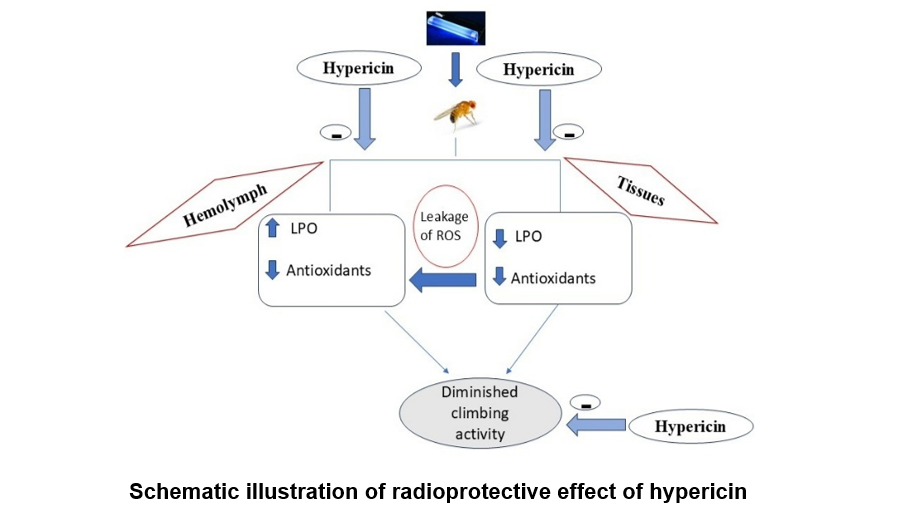
Hypericin, a polycyclic aromatic naphthodianthrone, is derived from the Hypericum genus and acts as a photosensitizer in the photodynamic therapy of numerous cancers. However, the mechanism of hypericin against skin cancer is not yet investigated. In the present study, the fruit flies were classified into six groups: Group I- control, Group II- UVC treated, Group III, IV, V and VI- UVC treated along with hypericin (0.1%, 0.2%, 0.4% and 0.8% respectively) exposed. Following the treatment, the climbing activity was assessed. Based on the behavioural study, 0.4% of hypericin was considered as an active dose and utilized for further experiments (Group I- Control; Group II- UVC exposed; Group III- UVC + Hypericin (0.4%); and Group IV- Hypericin (0.4%) alone). The levels of protein carbonyl content and thiobarbituric acid reactive substances were enhanced significantly (p<0.05) in hemolymph and diminished significantly (p<0.05) in the head and intestine of UVC-exposed D. melanogaster. The levels of GSH and the activities of SOD, GST, catalase and GPx were diminished significantly (p<0.05) in the circulation and tissues of UVC-exposed flies. Hypericin treatment significantly (p<0.05) nullifies the oxidative imbalance exerted by UVC and brings them back to near normal levels. Behaviour study is also supported the present findings. Further molecular research is needed to know the mechanism of action of hypericin and improve the fly model to utilize it for translational research, targeting to link the gap between preclinical findings and clinical studies.
Keywords: UVC radiation, hypericin, drosophila, oxidative stress, antioxidants