Green Synthesis of Silver Nanoparticles for Mosquito Control: A Review of Larvicidal Activity from Plant Extracts
Kaliyamoorthy Dass
*

Department of Zoology, Annai Vailankanni Arts and Science College, Affiliated to Bharathidasan University, Tiruchirappalli, Thanjavur, Tamil Nadu, India.
Pitchaimuthu Mariappan
Department of Zoology, Rajah Serfoji Govt. College (Autonomous) College, Affiliated to Bharathidasan University, Tiruchirappalli, Thanjavur, Tamil Nadu, India.
Packiyanathan Ramya
Department of Zoology, Tamilavel Umamaheswaranar Karanthai Arts College, Affiliated to Bharathidasan University, Tiruchirappalli, Karanthai, Thanjavur, Tamil Nadu, India.
Nagamuthu Prakash
Department of Chemistry, Annai Vailankanni Arts and Science College, Affiliated to Bharathidasan University, Tiruchirappalli, Thanjavur, Tamil Nadu, India.
*Author to whom correspondence should be addressed.
Abstract
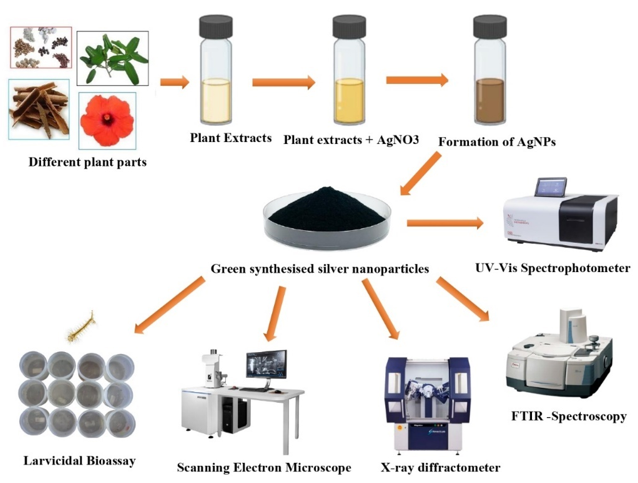
Mosquitoes transmit several deadly diseases such as brain fever, chikungunya, dengue fever, filariasis, hemorrhagic fever, Japanese encephalitis, malaria, dengue, and Zika. While synthetic chemical insecticides are commonly used for mosquito control, they pose significant risks to human health and the environment. As a result, plant-based insecticides have emerged as a promising alternative. Recent studies have shown that green-synthesized silver nanoparticles (AgNPs) derived from plant extracts exhibit potent larvicidal activity. This review highlights the effectiveness of silver nanoparticles in controlling mosquito populations, focusing on 80 plant species with demonstrated larvicidal properties. Among the plants, Annona squamosa, Artemisia nilagirica, and Nelumbo nucifera showed the most significant activity. The green synthesis of silver nanoparticles offers a more sustainable and environmentally friendly alternative to traditional chemical insecticides, providing a valuable strategy for controlling mosquito larvae and reducing the spread of vector-borne diseases.
Keywords: Green nanotechnology, larvicide, mosquitoes, silver nanoparticles, vector-borne diseases