Zebrafish Heart: A Model for Cardiovascular Research and Regeneration
L.S. Jyothika
Department of Pharmacology, Raghavendra Institute of Pharmaceutical Education and Research, K.R. Palli cross, under JNTUA, Anantapur, India.
Binaya Sapkota
Department of Pharmacology, Raghavendra Institute of Pharmaceutical Education and Research, K.R. Palli cross, under JNTUA, Anantapur, India.
Y. Sai Charan Teja
Department of Pharmacology, Raghavendra Institute of Pharmaceutical Education and Research, K.R. Palli cross, under JNTUA, Anantapur, India.
N. Vasavi
Department of Pharmacology, Raghavendra Institute of Pharmaceutical Education and Research, K.R. Palli cross, under JNTUA, Anantapur, India.
D. Yamini Kalyani
Department of Pharmacology, Raghavendra Institute of Pharmaceutical Education and Research, K.R. Palli cross, under JNTUA, Anantapur, India.
K. Somasekhar Reddy
Department of Pharmacology, Raghavendra Institute of Pharmaceutical Education and Research, K.R. Palli cross, under JNTUA, Anantapur, India.
Pasala Praveen Kumar *
Department of Pharmacology, Raghavendra Institute of Pharmaceutical Education and Research, K.R. Palli cross, under JNTUA, Anantapur, India.
*Author to whom correspondence should be addressed.
Abstract
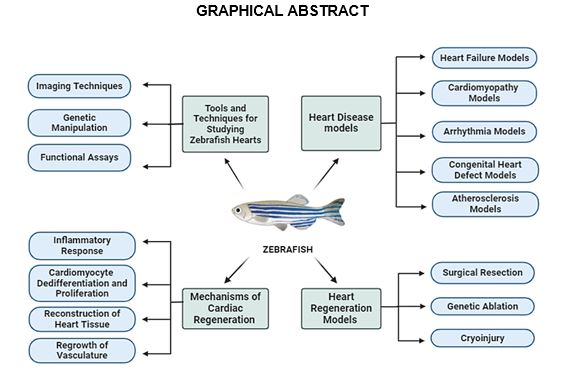
Zebrafish models are pivotal in cardiovascular research, offering a unique platform to study heart development, disease mechanisms, and potential therapies. Their transparent embryos and genetic manipulation tools, like CRISPR/Cas9, enable precise replication of human cardiac conditions such as heart failure, arrhythmias, and congenital defects. This accuracy is crucial for understanding disease pathways and testing new treatments effectively. These models simulate cardiac dysfunction through chemical disruptions, serving as robust platforms for drug discovery and testing. Their exceptional ability to regenerate heart tissue post-injury provides insights into treating human cardiovascular diseases. Various models, including surgical resection and genetic ablation, allow scientists to explore the mechanisms of cardiac regeneration, uncovering the roles of inflammation, cardiomyocyte dedifferentiation, and tissue reconstruction. Advanced imaging techniques like confocal microscopy offer detailed insights into cardiac dynamics, while electrophysiological recordings deepen the understanding of heart rhythms and abnormalities. High-throughput screening methods in zebrafish accelerate drug discovery efforts, aiding in the identification of potential treatments for diverse cardiovascular conditions. In essence, zebrafish models are invaluable tools for unraveling cardiovascular biology, clarifying disease pathways, and developing targeted therapies, with profound implications for improving cardiovascular disease management globally.
Keywords: Cardiovascular research, genetic manipulation, CRISPR/cas9, electrophysiological recordings, high-throughput screening, imaging techniques